
The Strength Testing Divide: Isometric and Heavy Strength Are Not Interchangeable
If you’re testing and developing maximal strength, this changes everything.

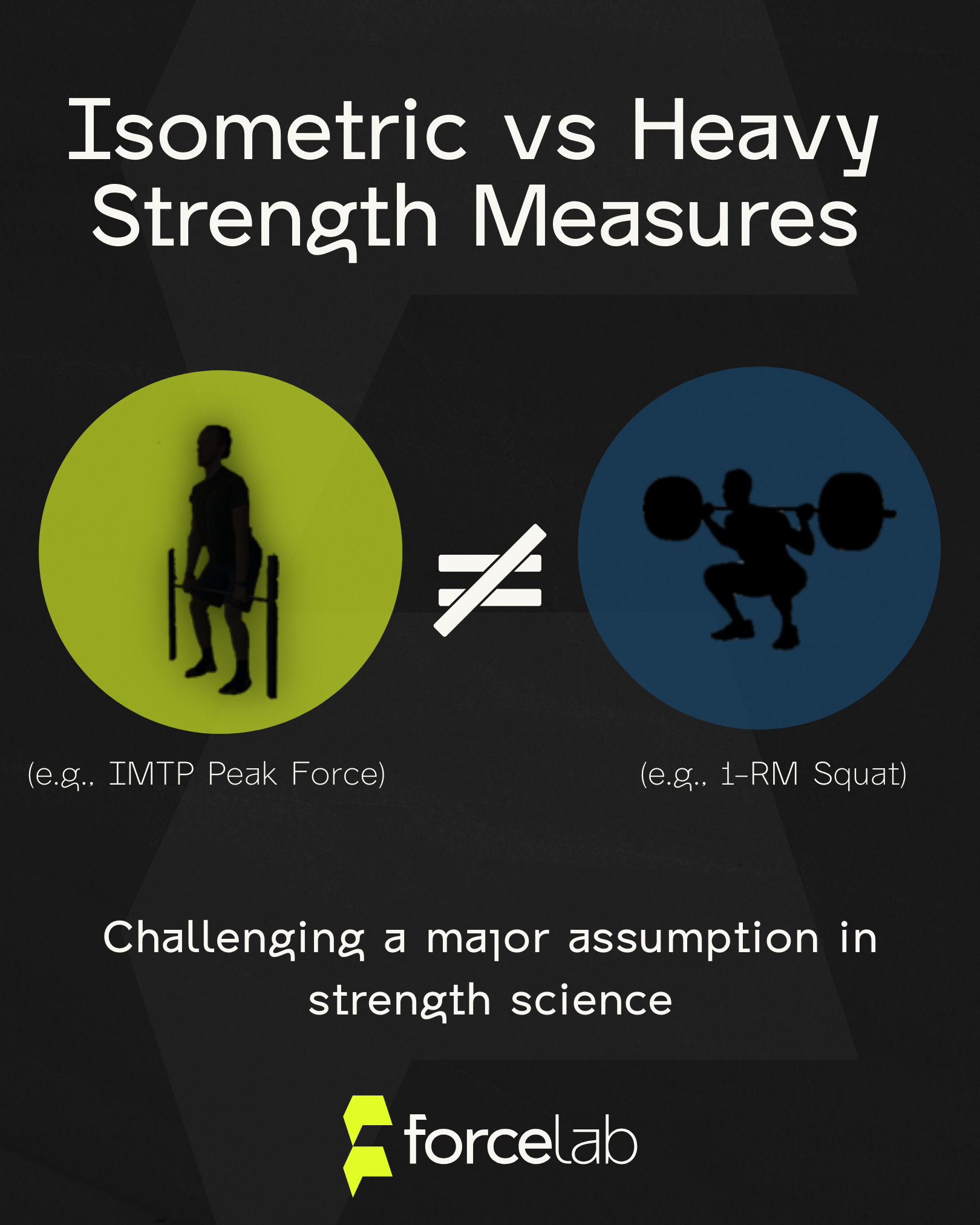
Understanding Strength Testing
Strength assessment is a fundamental part of sport science and strength and conditioning (S&C) practice. It provides critical insights into training adaptation, informs decision-making on athlete development, and helps manage fatigue across different training cycles. However, the way we measure strength matters.
Maximal strength can be assessed dynamically under heavy loads (e.g., 1/3/5RM back squat, deadlift, power clean) or isometrically (e.g., isometric mid-thigh pull [IMTP], isometric squat). These two methods are often used interchangeably or assumed to reflect the same underlying neuromuscular qualities. However, our systematic review and meta-analysis revealed that isometric and heavy strength represent distinct neuromuscular domains, with limited agreement between their changes following resistance training.
Understanding this distinction has direct implications for performance testing, training prescriptions, and how we interpret changes in maximal strength over time. If practitioners are using isometric strength assessments as a proxy for heavy dynamic performance, they may be making flawed assumptions about an athlete’s actual physical readiness and strength progression.
Key Findings
